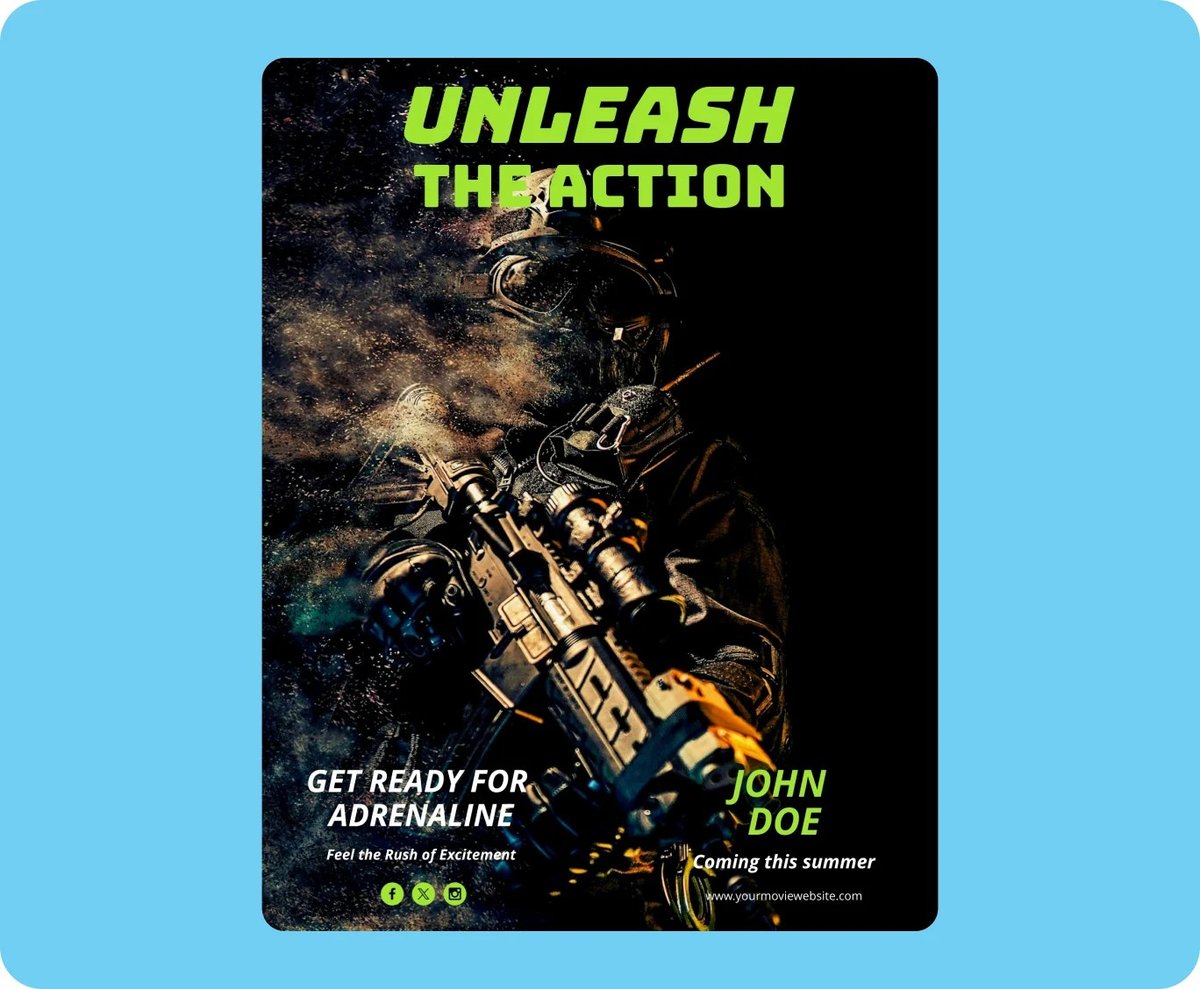
AI Movie Poster Editing & Post-Production Streamlines Design From Concept To Completion
In the fast-paced world of filmmaking, especially for indie creators and short film producers, the visual identity of your project can make or break its initial impact. Enter AI Movie Poster Editing & Post-Production, a transformative approach that's rapidly democratizing high-quality design, allowing you to craft stunning, professional-grade posters with unprecedented speed and efficiency. This isn't just about generating pretty pictures; it’s about a comprehensive workflow that leverages artificial intelligence to move your poster design from a nascent idea to a final, polished masterpiece, ready for the world stage.
Gone are the days of prohibitive costs or lengthy design cycles. AI tools are now empowering filmmakers, workshop organizers, and even book publishers to conceptualize, iterate, and finalize visual assets that perfectly encapsulate their creative vision, all without needing a team of graphic designers or a blockbuster budget.
At a Glance: What You'll Discover
- Speed & Efficiency: How AI slashes design time from weeks to minutes.
- Cost Savings: Eliminating traditional design agency fees.
- Creative Control: Leveraging detailed prompts to guide AI to your vision.
- Customization Power: Refining AI-generated designs with integrated editing tools.
- Copyright & Usage: Understanding the freedom and flexibility of AI-created assets.
- Beyond Films: Applying AI poster generation to events, music, and more.
- Best Practices: Crafting effective prompts and mastering iterative design.
The New Frontier: Why AI Is a Game-Changer for Poster Design
For years, a captivating movie poster was often a luxury, demanding significant investment in time, talent, and money. Indie filmmakers, in particular, often had to compromise, settling for less impactful visuals or relying on stretched in-house talent. AI has fundamentally shifted this paradigm, offering a powerful suite of tools that automate much of the creative heavy lifting, while still leaving ample room for human direction and refinement.
The core appeal lies in its ability to instantly generate high-quality, high-resolution images and typography that match a film’s aesthetic. Imagine describing your sci-fi thriller, specifying a "Cosmic" style, and having a stunning, ready-to-use poster appear in moments. This efficiency isn't just a convenience; it's a strategic advantage, freeing up resources and allowing creators to focus on their primary passion: storytelling.
From Concept to Canvas: The AI-Powered Workflow
The journey from a blank canvas to a compelling movie poster with AI tools is surprisingly intuitive, yet deeply powerful. It fundamentally changes how "editing" and "post-production" are perceived in this context, moving much of the heavy lifting to the prompt engineering and initial generation phase, while still offering crucial refinement stages.
Stage 1: The Blueprint – Crafting Your Vision Through Prompts
The heart of any AI-generated artwork lies in the prompt you provide. Think of it as giving precise instructions to a highly skilled, incredibly fast artist. The more detailed and clear your prompt, the closer the initial output will be to your desired result. This is where the "pre-production" of your poster truly begins.
Key Elements to Specify in Your Prompt:
- Genre & Theme: Is it a gritty noir, a whimsical fantasy, or a futuristic cyberpunk epic? Define the overarching mood.
- Main Subject: Who or what is the focal point? "A lone astronaut in a desolate red desert," or "A close-up of a defiant young woman's face, rain streaking down."
- Background & Setting: Where does the action take place? "A dark cityscape at dawn," "A serene, mist-shrouded forest," or "The swirling vortex of a black hole."
- Color Scheme & Lighting: What emotional tone do you want? "Vivid neon colors," "monochromatic tones with harsh shadows," "warm, golden hour light."
- Desired Text: Crucially, specify your film's title, tagline, key credits, and even a release date. AI tools like LightX can generate this typography directly into the poster, matching the overall style.
- Art Style/Era (Optional but Recommended): Referencing existing styles can significantly guide the AI. "Vintage-style action movie poster," "inspired by 1980s synthwave art," or "hyper-realistic 3D rendering."
Example Prompt Structures: - “Vintage-style action movie poster with the lead character front and center, dramatic lighting, bold title text 'THE UNSEEN', and a dark cityscape background.”
- “Sci-fi movie poster featuring a lone astronaut in space, vivid neon colors, and sleek, modern typography for the title 'COSMIC DRIFT' and tagline 'Beyond the Stars, Before the End'. Set in deep space with distant nebulae.”
Platforms like Venngage emphasize this clarity, noting that specific details about subject, background, color, and text are paramount for optimal results. It’s an iterative process, so don't be afraid to experiment with different phrasings.
Stage 2: The First Draft – AI Generation & Style Selection
Once your prompt is ready, the magic happens in seconds. Most AI movie poster generator tools guide you through a simple process:
- Enter Your Prompt: Input your detailed description into the text box.
- Choose a Style Preset: Select from a range of artistic styles offered by the platform. LightX, for instance, provides options like "Cosmic" for sci-fi, "Vintage" for classic looks, "Realistic," or "3D" for modern blockbusters. This choice dramatically influences the aesthetic of the output.
- Select Poster Size: Choose the appropriate dimensions – portrait, landscape, or square – depending on your intended use (e.g., social media, print, website banner).
- Generate: Click the button, and within moments, the AI will present its interpretation of your prompt.
The speed here is truly astonishing. What would take a human designer hours to conceptualize and rough out, the AI delivers instantly. This initial generation acts as your first draft, a strong foundation upon which to build.
Stage 3: Post-Production & Refinement – Bringing Your Vision to Life
This is where the "editing & post-production" truly comes into play for AI-generated posters. While the AI provides a powerful starting point, human oversight and refinement are crucial to achieving a truly unique and impactful design. This isn't about fixing AI errors as much as it is about finessing, customizing, and aligning the output perfectly with your brand.
Key Refinement Steps:
- Evaluate Initial Outputs: Review the generated posters critically. Does the AI capture the mood? Is the imagery compelling? Is the typography legible and stylistic?
- Generate Variations: Many tools allow you to generate multiple options from the same prompt or create variations of a promising design. This is invaluable for exploring different angles or subtle stylistic changes. If the first output isn't quite right, adjust your prompt and try again, perhaps tweaking a keyword or modifying the style.
- In-Platform Customization: Platforms like Venngage offer robust editing suites that allow you to modify the AI's output. This includes:
- Text Editing: Adjusting font styles, sizes, colors, and placement of titles, taglines, and credits.
- Layout Adjustments: Repositioning elements, resizing imagery, and ensuring visual balance.
- Visual Enhancements: Applying filters, overlays, or minor color corrections to fine-tune the mood.
- Adding Logos/Brand Elements: Seamlessly integrating your film studio's logo or other specific branding.
- External Editing (Optional): For those with advanced design skills, downloading the high-resolution image and performing further edits in professional software like Adobe Photoshop or GIMP can offer even greater control. This could involve compositing additional elements, complex color grading, or specific retouching.
- Feedback and Iteration: Share preliminary designs with your team or trusted peers. Gather feedback and use it to guide further refinements, either through more targeted AI prompts or manual adjustments.
The ability to customize and refine means you're not just accepting what the AI provides; you're actively collaborating with it, shaping the final product to your exact specifications. This iterative process is where true design magic happens, blending AI's speed with human creative direction.
Beyond Film: Versatility in AI Poster Generation
While "movie posters" are the primary focus, the underlying technology has far broader applications. The same tools and techniques can be adapted to create stunning visuals for a variety of purposes:
- Film Courses & Workshops: Design engaging promotional posters for educational events, clearly communicating themes and dates.
- Music Album Covers: Craft unique visual identities for singles, EPs, or full albums, perfectly capturing the genre and mood of your sound.
- Book Covers: Envision compelling artwork that draws readers in, whether for a sci-fi novel, a gripping thriller, or a heartwarming romance.
- Event Posters: Promote concerts, art exhibitions, conferences, or local gatherings with eye-catching designs.
- Marketing & Social Media: Generate countless variations for different platforms, ensuring consistent branding across all your digital channels.
The flexibility to create diverse visual assets from a single AI platform makes these tools indispensable for content creators of all stripes.
Mastering the Art of Prompt Engineering: Best Practices for AI Post-Production
The quality of your AI-generated poster is directly proportional to the quality of your prompt. Think of prompt engineering as the new "pre-visualization" stage for design.
Do's for Effective Prompting:
- Be Specific, But Not Overly Prescriptive: Provide clear details (e.g., "a futuristic cityscape at sunset, neon lights reflecting on wet streets") rather than vague terms ("city"). However, avoid dictating every pixel. Let the AI interpret.
- Define the Emotion/Tone: Use adjectives that convey the desired feeling: "gritty," "ethereal," "tense," "joyful," "mysterious."
- Use Keywords for Styles: Leverage terms like "cinematic," "photorealistic," "oil painting," "digital art," "vintage," "3D render," "anime style" to guide the artistic direction.
- Specify Color Palettes: Mentioning "deep blues and purples," "monochromatic sepia," or "vibrant reds and golds" helps steer the visual mood.
- Focus on Key Elements: Prioritize the most important visual components. If a character is central, describe them first and in detail.
- Include Negative Prompts (If Available): Some advanced tools allow you to specify what you don't want to see, helping to refine results (e.g., "not cartoonish," "no visible faces").
- Iterate and Refine: Your first prompt might not be perfect. Generate, analyze, tweak the prompt, and generate again. This iterative approach is key to success.
Don'ts for Prompting:
- Avoid Vagueness: "A nice movie poster" will yield generic results.
- Don't Overload with Unnecessary Details: Too many conflicting instructions can confuse the AI. Focus on the core message.
- Expect Perfection on the First Try: AI is a tool; it requires guidance and refinement, much like a human artist.
- Forget to Specify Text: If you need typography on the poster, explicitly state the title, tagline, etc., and ideally, its desired style (e.g., "bold, futuristic title 'CYBERPUNK'").
Addressing Common Questions and Misconceptions
Is AI-generated content truly copyright-free?
Many AI movie poster generators, including Venngage, explicitly state that their AI-generated designs are fully customizable and copyright-free for both personal and commercial use. This is a significant benefit, removing common legal hurdles associated with using pre-made templates or stock imagery. Always check the specific terms of service for the platform you are using, as policies can vary.
Do I need design skills to use these tools?
No. These platforms are designed for ease of use, often employing intuitive interfaces. Your primary skill will be crafting clear and descriptive text prompts, which is more about communication than graphic design expertise. The in-platform customization tools are typically user-friendly, requiring no prior design software experience.
Can AI truly replace a human designer?
While AI can automate much of the initial creative process and generate high-quality outputs, it doesn't entirely replace the strategic thinking, nuanced understanding of brand identity, or the emotional intelligence a human designer brings. AI is a powerful assistant, accelerating workflow and opening new possibilities, but the ultimate vision and refinement still benefit from a human touch.
What about the resolution and quality for print?
Platforms like LightX emphasize generating "high-quality, high-resolution posters." When downloading, always select the highest available resolution to ensure your poster looks crisp and professional, whether for digital display or large-format printing.
The Future is Collaborative: AI as Your Creative Partner
AI Movie Poster Editing & Post-Production isn't just a trend; it's a fundamental shift in how creative assets are generated and refined. For independent filmmakers, small businesses, and content creators, it offers an unprecedented opportunity to elevate their visual storytelling without breaking the bank. The power lies not just in the AI's ability to create, but in your ability to guide, refine, and put the final stamp of your unique vision on its output.
By embracing these intelligent tools, you're not just making posters; you're unlocking new levels of creativity and efficiency, ensuring your projects capture attention and leave a lasting impression. Dive in, experiment with your prompts, and discover how AI can transform your design workflow from concept to completion.